

Rubber & Plastics
Surface Treatments for Mineral Masterbatches
Surface treatments for mineral masterbatches help producers incorporate powder into a carrier resin and deliver that mineral consistently during downstream letdown. Selecting around both stages gives you a concentrate that can be evaluated for stable pellet production and for useful dispersion in the final article.
LANDUSIL supplies mineral-surface and powder-handling ingredients for concentrate development. Typical projects include calcium carbonate in PE, talc in PP, mixed-mineral pellets and concentrates intended for film, sheet, profile or injection-molding applications.
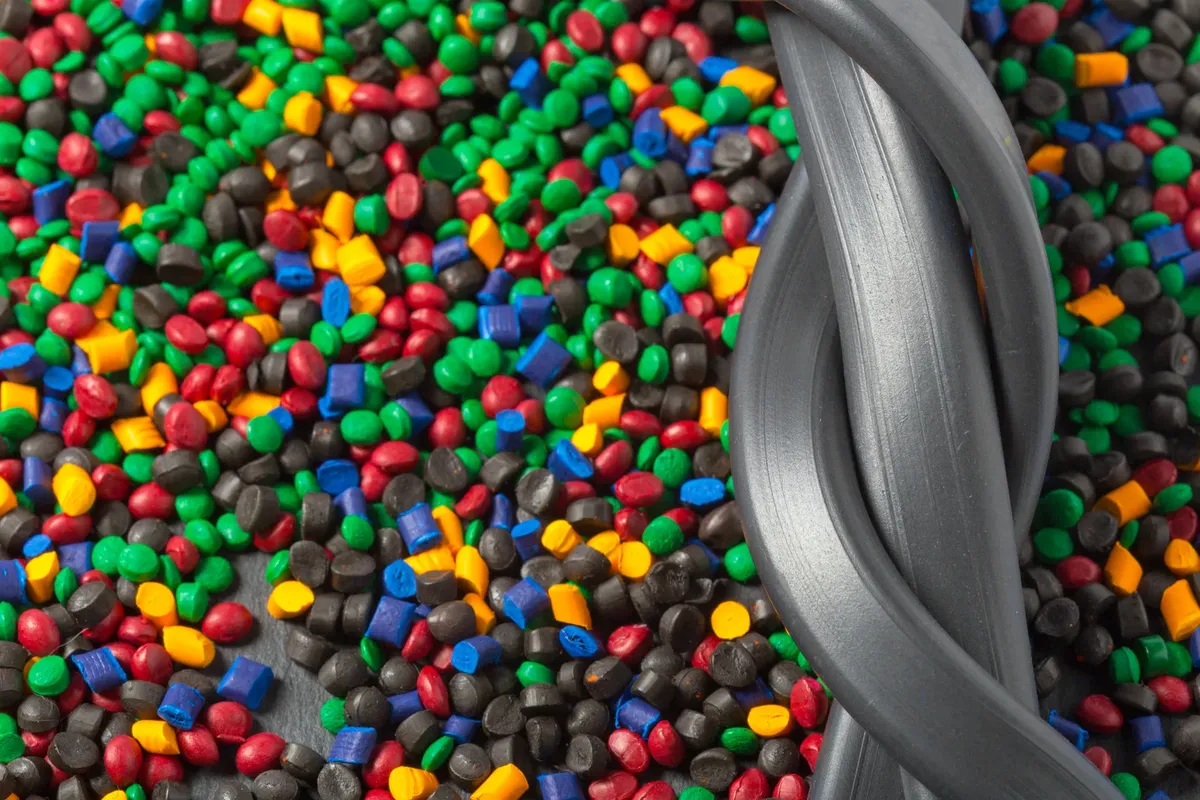
What Surface Treatments for Mineral Masterbatches Do
- Improve mineral wetting. A suitable treatment helps the powder interact with the carrier during incorporation.
- Support consistent feeding. Controlled powder condition and handling can improve delivery into the compounder.
- Manage agglomeration. Uniform treatment gives you a practical variable for developing dispersion through compounding.
- Provide organic-surface choices. Titanate, aluminate and alkyl-silane routes address different mineral and carrier combinations.
- Connect concentrate and final use. Following the treatment through letdown helps retain the properties required by the customer.
Typical Uses
Concentrate: Calcium carbonate in PE carrier
What matters most
Existing powder coating, wetting, pellet integrity and receiving-resin compatibility
Concentrate: Talc in PP carrier
What matters most
Platelet dispersion, pellet quality and directional properties after dilution
Concentrate: Mixed-mineral pellets
What matters most
Blend consistency, treatment distribution and local segregation
Concentrate: Mineral pellets with a treatment package
What matters most
Active and carrier accounting through the complete formula
Concentrate: Film-grade mineral concentrates
What matters most
Redispersion, agglomerates, holes and directional strength
Concentrate: Injection-molding concentrates
What matters most
Surface finish, dimensions, stiffness and impact balance
Recommended LANDUSIL Products
| Product | Chemistry | CAS | Why choose it |
|---|---|---|---|
| LANDUSIL LATERA 1010-L | Isopropyl titanium triisostearate | 61417-49-0 | Titanate route for mineral wetting and concentrate-pellet development |
| LANDUSIL LATERA 2010-L | Aluminate coupling-agent formulation | Mixture – see SDS | Aluminate treatment route for powder incorporation and carrier compatibility |
| LANDUSIL LEGRA 5050-L | n-Octyltriethoxysilane | 2943-75-1 | Alkyl surface modification on suitable reactive minerals |
| LANDUSIL SIVERA 6020-P | Silicone powder rheology and anti-caking additive | Mixture – see SDS | Dry-powder storage and metering route ahead of concentrate manufacture |
How to Select the Treatment and Carrier
Define both mass balances
State mineral content in the concentrate and mineral content required in the final article. Define masterbatch addition on a mass basis and identify any mineral already in the receiving formula. Carry the carrier resin and treatment package through the same calculation.
Select the carrier for concentrate manufacture and final-resin dispersion. The amount entering a highly filled pellet may be modest, yet its compatibility can still matter in a sensitive film or molded-part formulation.
Choose around the mineral surface
Record powder identity, particle distribution, surface area, moisture and existing coating. LATERA 1010-L provides a fatty-acid titanate route; LATERA 2010-L provides an aluminate formulation route. Each has its own composition, carrier and compatibility questions.
LEGRA 5050-L supplies an octyl group and ethoxy-based surface chemistry for appropriate minerals. Its role centers on mineral-surface modification and interaction with the organic phase. Powder-specific preparation is covered by Calcium Carbonate Filler Treatment and Talc and Mica Platelet Treatment.
Keep dry handling and melt dispersion clear
SIVERA 6020-P addresses powder flow and anti-caking development before compounding. Use storage, hopper discharge and metering observations to assess that role. A selected powder-handling aid then travels through melt processing and final letdown as part of the formula.
Choose offline treatment or direct incorporation according to distribution and the available equipment. Document the powder condition delivered to the extruder, including any drying or conditioning needed by the chosen process.
Application and Evaluation Guidelines
These ingredients support formulation work; they are not finished mineral masterbatches. Confirm active content, carrier and supplied composition in current grade documents. Consult the SDS for powder and liquid handling, and account for treatment moisture, residual solvents and reaction products before melt processing. Ethoxy-silane hydrolysis can release ethanol.
Carbonate surfaces need their own treatment model. Conventional silane bonding to silica does not establish the same durable attachment on calcium carbonate. Likewise, wetting or hydrophobicity alone cannot establish covalent coupling to unmodified PP or PE. Compare the actual treated powder and final compound.
| Stage | What to establish |
|---|---|
| Powder preparation | Treatment distribution, moisture, agglomeration and storage behavior |
| Feeding | Consistency, segregation, bridging and dosing variation |
| Melt compounding | Torque, pressure, dispersion and volatile-related defects |
| Pelletizing | Composition, weak regions, fines and storage integrity |
| Letdown | Distribution in the customer's resin at the stated addition rate |
| Final article | Film defects or molded appearance, dimensions and mechanical retention |
Run the concentrate in the actual downstream process. Film stretching, injection molding and profile extrusion impose different mixing and deformation histories. Compare at equivalent final mineral content, with deliberate carrier or lubrication changes recorded.
A pellet that looks uniform does not establish final-film integrity or impact performance. Test representative letdown levels, storage states and receiving-resin variability. Include printing, bonding or coating where these affect acceptance. Set criteria for both stable concentrate production and acceptable diluted-product behavior before increasing scale.

Frequently Asked Questions
How should a high-loading mineral masterbatch be evaluated?
Assess treated powder, feeding, melt dispersion and pellet integrity, then run the actual letdown into the customer's resin. Final surface and mechanical tests connect concentrate manufacture with the intended application.
What information is needed to choose the carrier resin?
Provide concentrate loading, receiving resin, mass-based addition rate and downstream process. The carrier must suit pellet manufacture and disperse acceptably during the available letdown history.
Which treatment should I compare for calcium-carbonate concentrate?
Begin with the existing carbonate coating and carrier. Titanate and aluminate wetting routes offer useful comparisons with any surface-specific treatment approach. Use the same powder and final mineral content when interpreting results.

Samples and Technical Support
LANDUSIL provides samples, TDS, SDS and selection support for mineral-concentrate ingredients. Please include:
- Mineral grade, surface coating, moisture and target concentrate loading
- Carrier and receiving resin with a mass-based letdown rate
- Powder-treatment, compounding and pelletizing equipment
- Current feeding, pellet or final-article defects and required properties
- Estimated quantity, preferred packaging and destination country