

Mineral & Filler Treatment
Powder Flow and Anti-Caking Additives
Well-chosen powder flow and anti-caking additives help you develop reliable discharge, metering and incorporation across storage and production. The useful route depends on the cause of poor handling, from dry cohesion and moisture-related bridges to pressure consolidation or changes in particle distribution.
LANDUSIL supplies silicone resin micropowder, formulated powder-processing additives and alkylsilane ingredients for industrial powder developers. Choose between a particulate addition and controlled host-surface modification using the powder, storage conditions and next formulation step.
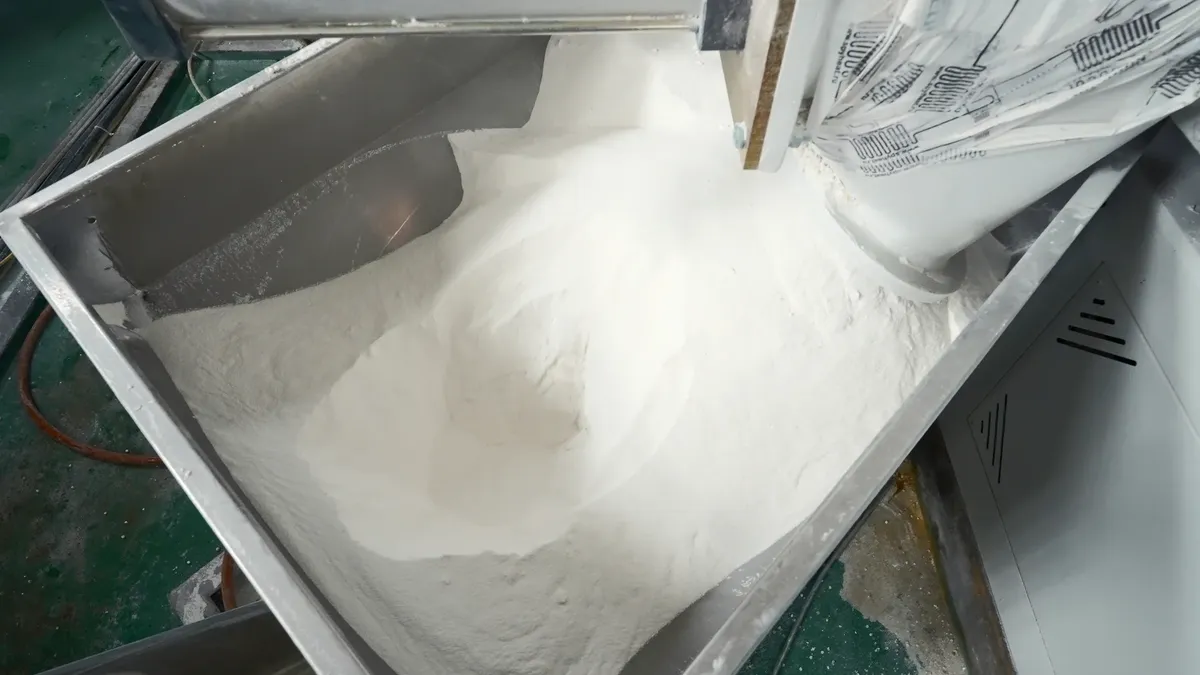
What Processing Additives Do for Powder Handling
- Adjust particle contacts. A suitable particulate additive offers a route to change interactions between host particles.
- Support consistent feeding. Better-controlled powder state helps you address discharge and metering variability.
- Target moisture-related behavior. A designed surface treatment can modify affinity for moisture on a suitable mineral.
- Connect storage with use. A focused program follows caking, redispersion and feeding after relevant conditioning.
- Support a practical handling package. Additive selection can be developed alongside mixing, transfer, packaging and equipment operation.
Typical Uses
End use: Functional mineral powders in storage
What matters most
Flow after consolidation, caking and retained downstream function
End use: Pigments and fillers for powder coatings
What matters most
Feed accuracy, segregation, dust and coating incorporation
End use: High-surface-area powder feeding
What matters most
Cohesion, aeration and response under relevant stress
End use: Composite powder after drying
What matters most
Residual liquid, agglomeration and changes during storage
End use: Powder exposed to humidity cycles
What matters most
Moisture, cake strength, redispersion and later wetting
Recommended LANDUSIL Products
| Product | Chemistry | CAS | Why choose it |
|---|---|---|---|
| LANDUSIL SIVERA 6010-P | Silicone Resin Micropowder | Mixture – see SDS | Silicone resin particle route for comparing physical powder contacts and handling in the actual host powder |
| LANDUSIL SIVERA 6020-P | Silicone Powder Rheology Additive | Mixture – see SDS | Formulated processing-additive route focused on feeding, flow and caking under defined storage conditions |
| LANDUSIL LEGRA 5030-L | n-Propyltriethoxysilane | 2550-02-9 | Propylsilane route for controlled modification of a suitable mineral surface before drying and flow assessment |
How to Select Powder Flow and Anti-Caking Additives
Identify where handling fails
Describe the powder and the point at which the defect appears. Initial discharge, a hopper restart and incorporation after warehouse storage are different operating scenes. Record moisture, particle distribution, any liquid component and existing treatment.
Dry fine particles can be cohesive, wet powders can develop liquid bridges, and softer particles can deform under pressure or heat. Use the observed failure to choose the trial. Include the behavior of the equipment, such as bridging, flooding, aeration and inconsistent bulk density.
Choose particulate addition or host treatment
A particulate route focuses on the contacts between host particles. The additive's supplied identity and distribution guide the comparison. Silicone resin particles and a formulated powder-processing additive provide different starting materials, so use their current grade documentation when setting up the trial.
A chemical surface route modifies the host mineral through suitable sites and a defined reaction. For propylsilane treatment, include reagent distribution, moisture, reaction and drying in the process plan. The conditioned powder then enters the storage and feeding comparison.
Make mixing and delivery part of the design
Select mixing exposure for useful additive distribution and the condition of the actual host. Follow particle changes and composition through transfer and packaging. This helps explain whether the material arriving at the feeder represents the laboratory blend.
Include startup, steady running and restart after a relevant pause. A stable feed into the next process is a useful development objective alongside the powder's storage response. For coating manufacture, see powder coatings and powder processing.
Application and Evaluation Guidelines
Compare untreated powder and the current treatment with the new route. Keep host grade, additive amount and conditioning visible. Use appropriate flow measurements for the stress and consolidation expected in storage or the hopper. Simple pouring or angle-of-repose observations can guide screening; include suitable shear or consolidated-flow assessment where the process requires it.
Evaluate caking after representative humidity, temperature and loading history. Distinguish loose agglomerates that redisperse from a persistent cake. Follow practical feed consistency, dust, segregation and fine-fraction changes after storage and transport.
A liquid silane does not act as a ready-made particulate flow aid. Residual liquid can increase stickiness, so assess the completed treatment and drying state. Initial free flow does not establish long-term anti-caking behavior, and a more hydrophobic surface does not establish better downstream incorporation.
For powders later mixed with water, assess wetting and redispersion. For coatings and bonded materials, include cure, adhesion and film defects. For a conductive powder, verify the required electrical behavior after treatment. Judge the full functional balance before selecting a handling route.
Use current SDS information for particulate handling and the chosen chemical process. Propyltriethoxysilane hydrolysis releases ethanol; follow relevant residuals in the delivered powder.
Frequently Asked Questions
What is the difference between a flow aid and a silane treatment?
A particulate flow aid addresses particle contacts through physical addition. A silane route uses suitable mineral sites and a controlled reaction, followed by conditioning before storage and feeding assessment.
How do I choose an anti-caking additive for mineral powder?
Identify the powder, moisture and pressure or humidity history behind the failure. Compare a suitable route using consolidated flow, cake behavior and actual feeding, with downstream function retained in the assessment.
How much powder-processing additive should I use?
Plan trial levels using the host's particle and surface information and the supplied additive composition. Relate distribution to storage flow and feeder response, then assess the receiving formulation.
What should I test after a powder passes a pouring test?
Check flow after realistic consolidation and storage, followed by startup and restart at the actual feeder. Include segregation, dust and incorporation into the intended water, resin or melt process.

Samples and Technical Support
LANDUSIL provides samples, TDS, SDS and selection support for industrial powder handling. Please include:
- Host composition, particle distribution, moisture and current treatment
- Failure location and available flow, caking or dosing observations
- Storage, transport, packaging and hopper or feeder conditions
- Mixing equipment, final formulation and functions to preserve
- Estimated quantity, packaging preference and destination country