
Technical Data Sheet
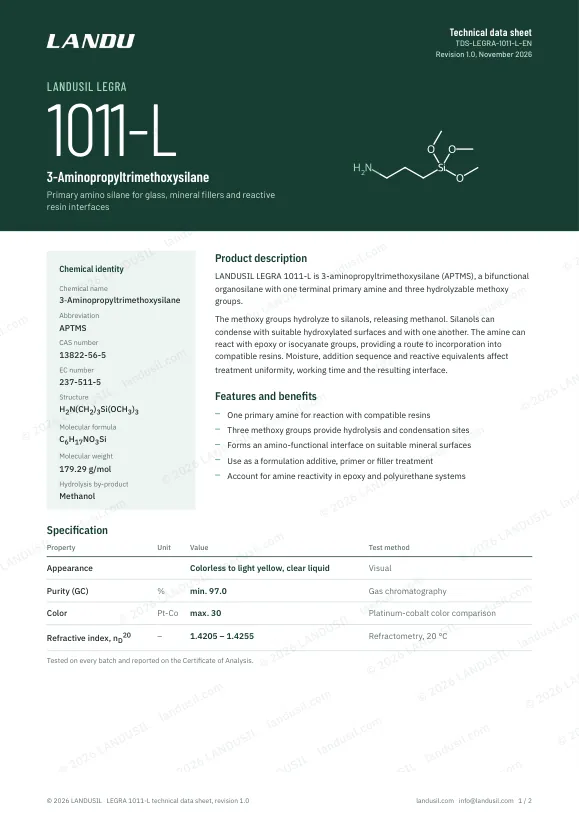
LANDUSIL LEGRA 1011-L
Specification limits, typical properties, guidelines for use, handling, storage and packaging in one document.
FamilyGrades

LEGRA · Amino & Nitrogen-Functional Silanes
LANDUSIL LEGRA 1011-L is 3-aminopropyltrimethoxysilane (APTMS, CAS 13822-56-5), a primary amino silane for building reactive interfaces in adhesives and inorganic surface treatments. It brings a terminal amine and a moisture-reactive silicon end into the same molecule.
Choose this methoxy route when your development process calls for amino functionality on glass, suitable mineral fillers or cleaned substrate surfaces. It supports both separate surface treatments and selected formulation additions, with the receiving resin determining how the amine is used.

| Item | Information |
|---|---|
| Product | LANDUSIL LEGRA 1011-L |
| Chemical name | 3-Aminopropyltrimethoxysilane |
| Common abbreviation | APTMS |
| CAS number | 13822-56-5 |
| Molecular formula | C6H17NO3Si |
| Molecular weight | 179.29 g/mol |
| Structure | H2N(CH2)3Si(OCH3)3 |
| EC number | 237-511-5 |
| Hydrolysis by-product | Methanol |
| Product family | Amino & Nitrogen-Functional Silanes |
| Property | Value | Test method |
|---|---|---|
| Appearance | Colorless to light yellow, clear liquid | Visual |
| Purity (GC) | min. 97.0 % | Gas chromatography |
| Color | max. 30 Pt-Co | Platinum-cobalt color comparison |
| Refractive index, nD20 | 1.4205 – 1.4255 | Refractometry, 20 °C |
| Property | Typical value |
|---|---|
| Boiling point, 15 mmHg | approx. 92 °C |
| Flash point, closed cup | approx. 79 °C |
| Kinematic viscosity, 25 °C | approx. 1.68 mm²/s |
| Behavior in water | Hydrolyzes and releases methanol |
| Density | 1.027 g/mL (25 °C) |
Typical values are provided for reference only and are not to be construed as specifications. Please refer to the current Technical Data Sheet (TDS) and Certificate of Analysis (CoA) for the supplied grade.
Technical Data Sheet
Specification limits, typical properties, guidelines for use, handling, storage and packaging in one document.

The amine can take part in epoxy reactions while the silicon end provides surface-treatment functionality. Use LEGRA 1011-L to develop compatible mineral or substrate interfaces for Epoxy Structural Adhesives and Dissimilar-Material Assembly.

The polyol side of a two-component formulation is a route to investigate for a polyurethane adhesion promoter. In Polyurethane Industrial Assembly Adhesives, the amine consumes isocyanate and forms urea connections when the components react.
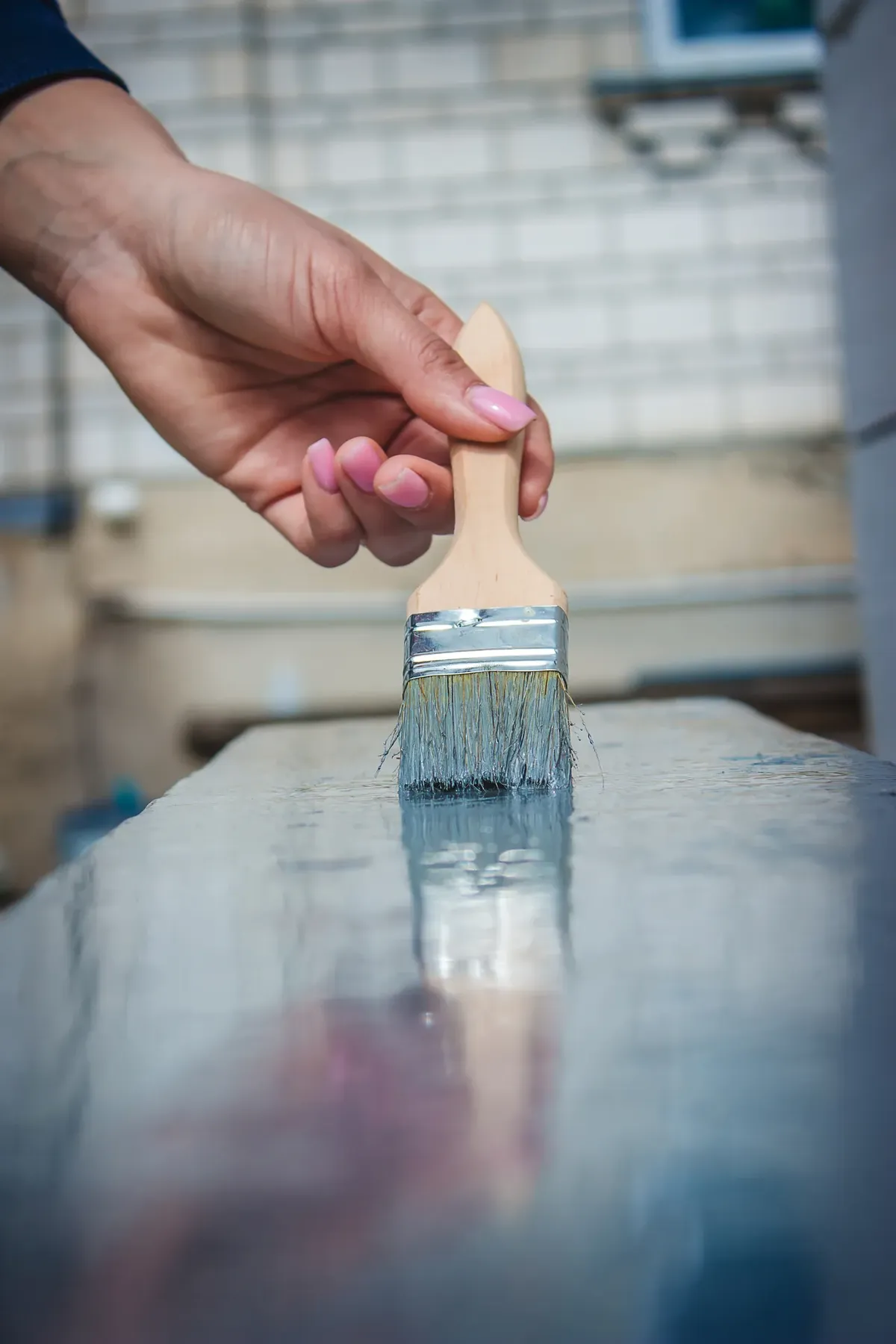
A separate primer places APTMS on the substrate before you apply the adhesive. Glass and Ceramic Bonding Primers is relevant when you need to coordinate surface cleaning, deposited layer formation and the next bonding step.

Use it as one ingredient in a sizing package applied to formed, cooled glass filaments. In Glass Fiber Sizing and Strand Treatment, the coupling chemistry works with the film former and lubricant to connect the glass surface with the intended matrix.
Explore an amino-functional treatment on suitable hydroxylated silica before compounding into a compatible reactive resin. Quartz and Fused Silica Treatment provides the process context for comparing surface coverage, drying and subsequent resin contact.
Set the addition point before preparing the treatment. For an aqueous bath, define the water balance, mixing order and usable application window. Methoxy hydrolysis generates silanol-containing species and methanol; later condensation changes the treatment layer as it develops.
For direct adhesive addition, identify the component that will receive the silane and account for its amine contribution. Compare working time, viscosity growth, storage behavior and conditioned bond performance with a reference. Include pH, dispersion stability and residual volatiles when water is present. Evaluate ketone- or ester-containing solvents for compatibility with the primary amine. Check contact cure separately around platinum-catalyzed silicones, and check catalyst response in acid-catalyzed or cationic formulations.
When comparing APTMS with APTES, use the intended process and equivalent reaction basis. A change in alkoxy chemistry changes by-products and bath development; a hydrolysis-rate comparison alone does not establish finished-adhesive cure speed or strength.
These levels are starting points. Determine the optimum level and method in trials under your own production conditions.
They share the aminopropyl group but have different alkoxy groups. APTMS has methoxy groups; APTES has ethoxy groups.
Water starts hydrolysis. A working primer also needs a defined preparation procedure, application window and compatible ingredients, established in your process trials.
The primary amine reacts with isocyanate. Deliberate prepolymer reaction is a synthesis operation; component storage requires its own formulation design.
Its organic functionality is a primary amine. Select a corresponding unsaturated silane when the process requires methacrylate copolymerization.

Samples, current TDS and SDS, and technical selection support are available from LANDUSIL. Please provide: