
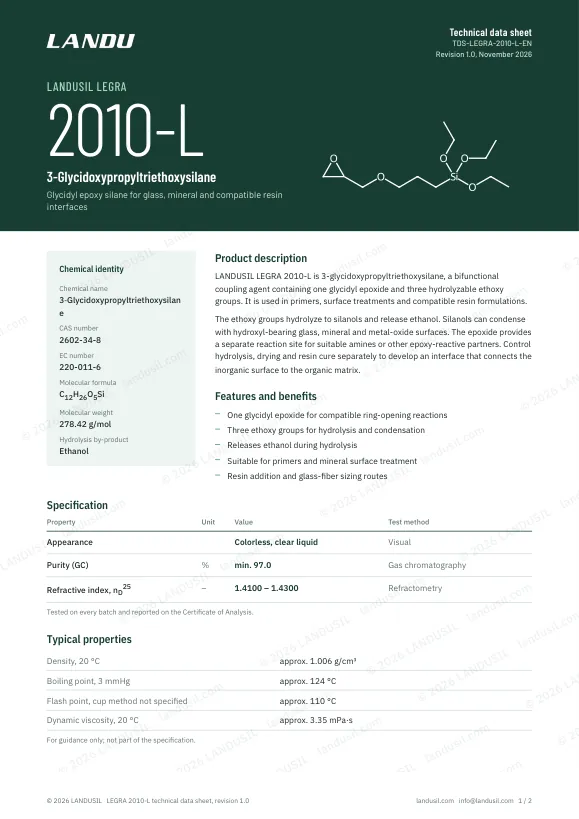
Technical Data Sheet
LANDUSIL LEGRA 2010-L
Specification limits, typical properties, guidelines for use, handling, storage and packaging in one document.
FamilyGrades

LEGRA · Epoxy Silanes
LANDUSIL LEGRA 2010-L is 3-glycidoxypropyltriethoxysilane (CAS 2602-34-8), a glycidyl epoxy silane for connecting suitable inorganic surfaces with compatible reactive resins. It combines one glycidyl epoxide with three hydrolyzable ethoxy groups on silicon.
This gives adhesive, coating and composite formulators two reaction paths to work with: epoxide chemistry on the organic side and hydrolysis followed by condensation on the silicon side. Ethoxy hydrolysis releases ethanol, distinguishing the route from the corresponding methoxy grade.

| Item | Information |
|---|---|
| Product | LANDUSIL LEGRA 2010-L |
| Chemical name | 3-Glycidoxypropyltriethoxysilane |
| Alternative name | Triethoxy(3-glycidyloxypropyl)silane |
| CAS number | 2602-34-8 |
| Molecular formula | C12H26O5Si |
| Molecular weight | 278.42 g/mol |
| Functional groups | One glycidyl epoxide and one triethoxysilyl group |
| EC number | 220-011-6 |
| Hydrolysis by-product | Ethanol |
| Product family | Epoxy Silanes |
| Property | Value | Test method |
|---|---|---|
| Appearance | Colorless, clear liquid | Visual |
| Purity (GC) | min. 97.0 % | Gas chromatography |
| Refractive index, nD25 | 1.4100 – 1.4300 | Refractometry |
| Property | Typical value |
|---|---|
| Density, 20 °C | approx. 1.006 g/cm³ |
| Boiling point, 3 mmHg | approx. 124 °C |
| Flash point, cup method not specified | approx. 110 °C |
| Dynamic viscosity, 20 °C | approx. 3.35 mPa·s |
Typical values are provided for reference only and are not to be construed as specifications. Please refer to the current Technical Data Sheet (TDS) and Certificate of Analysis (CoA) for the supplied grade.
Technical Data Sheet
Specification limits, typical properties, guidelines for use, handling, storage and packaging in one document.

Add the silane as a coupling ingredient within a film-former and lubricant package matched to the matrix. In Glass Fiber Sizing and Strand Treatment, treatment after filament formation and later fabric finishing are different operations.
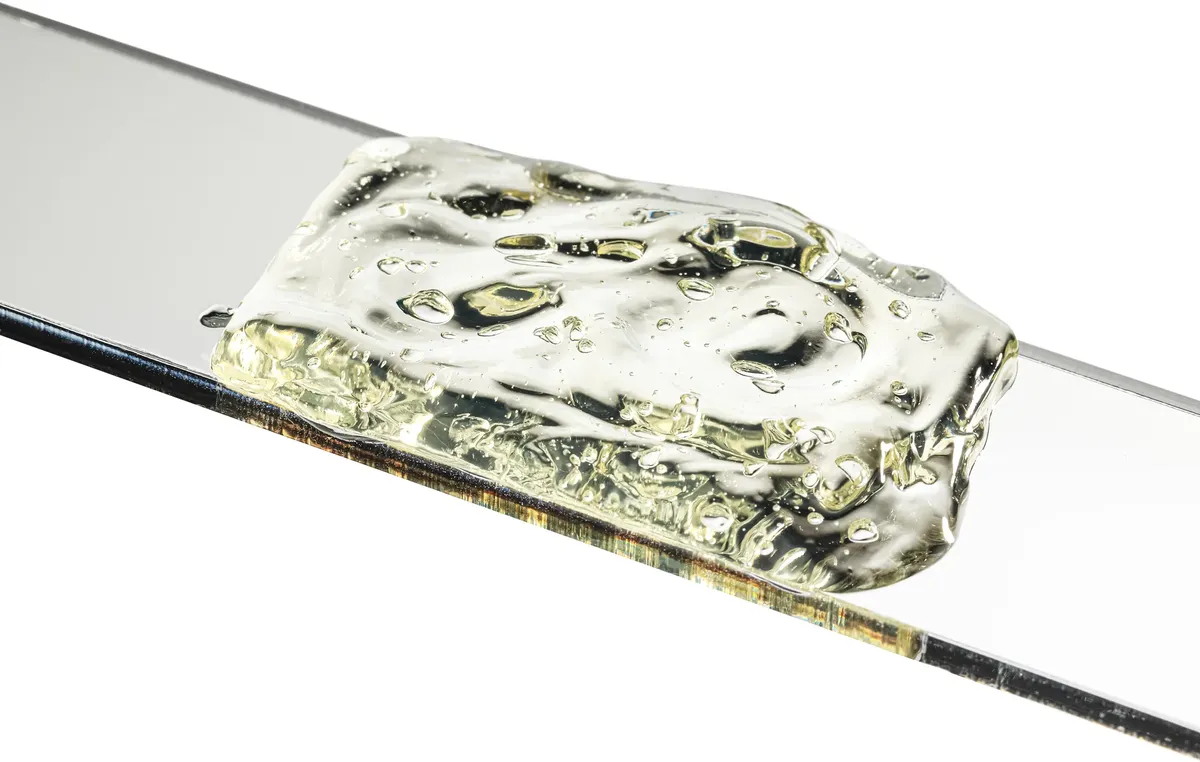
Use the epoxide with a suitable hardener or other defined reaction partner in a compatible formulation. Epoxy Structural Adhesives and Dissimilar-Material Assembly provides the context for choosing between separate substrate treatment and direct resin addition.

Formulate a pretreatment or coating addition for suitable cleaned oxide-bearing metal surfaces. In Industrial Equipment & General Metal Protective Coatings, the binder, surface preparation and full coating construction determine how the interface develops.
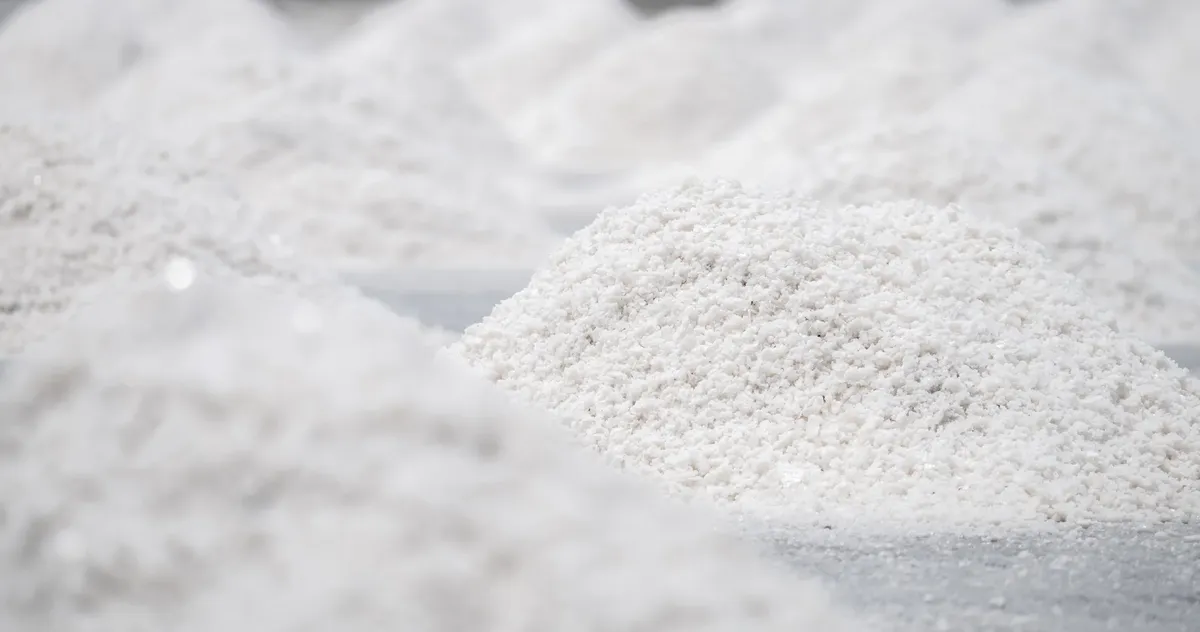
Explore pretreatment of suitable hydroxylated powder surfaces before resin mixing. Quartz and Fused Silica Treatment links deposition and drying with subsequent filler dispersion and the receiving resin reaction.

Use the silane as an upstream precursor in a controlled hydrolysis and condensation route. For Epoxy-Functional Siloxane Intermediates, the intended residual epoxide and silicon structure need to be established in the resulting material.
Define the organic reaction partner before choosing the treatment sequence. The starting epoxide can react with suitable amines or in another specifically initiated epoxy reaction. Separately, ethoxy hydrolysis forms silanol species and ethanol; surface deposition and self-condensation compete within that process.
Compare untreated or additive-free references at matched formulation and processing conditions. For glass sizing, assess bath behavior, drying, fiber handling and moisture-conditioned composite properties. For fillers, follow dispersion, viscosity and residual volatiles together with cure. For metal primers, measure conditioned adhesion and failure location on the actual surface.
Establish bath working life and retained epoxide analytically where a later organic reaction is intended. Water-sensitive nitride powders require a separate surface and moisture assessment. UV development needs an explicit initiation route: glycidyl epoxide is different from an acrylate or vinyl group used in ordinary radical copolymerization. The starting silane also needs a demonstrated partner before assigning it a direct reaction with an NCO or acrylic formulation.
These levels are starting points. Determine the optimum level and method in trials under your own production conditions.
It supplies an epoxide group. A compatible hardener or defined initiation system provides the other part of the intended epoxy reaction.
Ethoxy hydrolysis releases ethanol. Confirm supplied-grade composition and residual alcohol separately when those are purchase requirements.
It has no acrylate or vinyl group for that copolymerization route. Epoxy UV development needs its own initiation and compatibility design.
It is a starting silane molecule. Oligomer structure and retained functional groups depend on the controlled reaction used to make the intermediate.

LANDUSIL provides samples, current TDS and SDS, and technical selection support. Please include: