
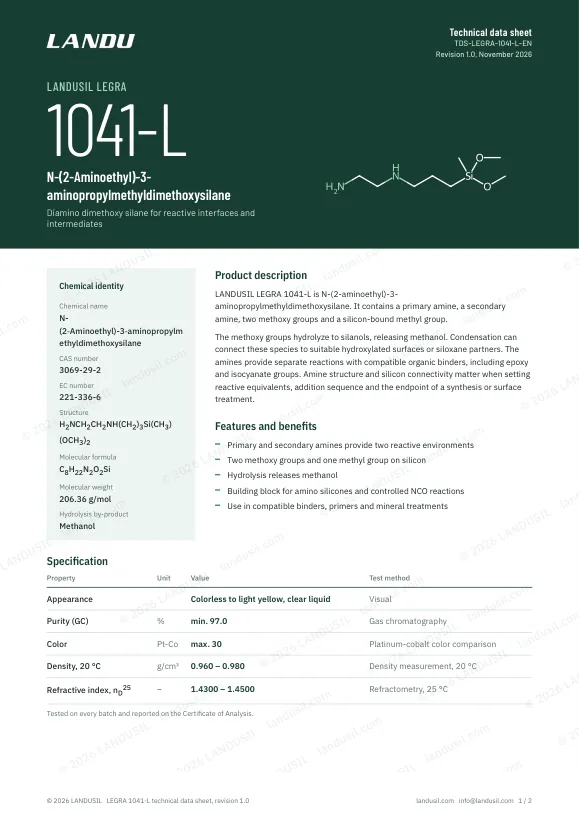
Technical Data Sheet
LANDUSIL LEGRA 1041-L
Specification limits, typical properties, guidelines for use, handling, storage and packaging in one document.
FamilyGrades

LEGRA · Amino & Nitrogen-Functional Silanes
LANDUSIL LEGRA 1041-L is aminoethylaminopropylmethyldimethoxysilane (CAS 3069-29-2), a diamino dimethoxy silane for reactive binder interfaces and organosilicon intermediates. Its primary and secondary amines provide two different nitrogen environments, while the silicon atom carries two methoxy groups and a methyl group.
This structure gives adhesive, molding-compound and silicone developers a way to design amino functionality and silicon connectivity together. The material can enter a selected resin, a separate primer or a controlled synthesis step.

| Item | Information |
|---|---|
| Product | LANDUSIL LEGRA 1041-L |
| Chemical name | N-(2-Aminoethyl)-3-aminopropylmethyldimethoxysilane |
| CAS number | 3069-29-2 |
| Molecular formula | C8H22N2O2Si |
| Molecular weight | 206.36 g/mol |
| Structure | H2NCH2CH2NH(CH2)3Si(CH3)(OCH3)2 |
| Organic functionality | One primary amine and one secondary amine |
| EC number | 221-336-6 |
| Hydrolysis by-product | Methanol |
| Product family | Amino & Nitrogen-Functional Silanes |
| Property | Value | Test method |
|---|---|---|
| Appearance | Colorless to light yellow, clear liquid | Visual |
| Purity (GC) | min. 97.0 % | Gas chromatography |
| Color | max. 30 Pt-Co | Platinum-cobalt color comparison |
| Density, 20 °C | 0.960 – 0.980 g/cm³ | Density measurement, 20 °C |
| Refractive index, nD25 | 1.4300 – 1.4500 | Refractometry, 25 °C |
| Property | Typical value |
|---|---|
| Boiling point, 25 mmHg | approx. 139 °C |
| Flash point, closed cup | approx. 90 °C |
| Kinematic viscosity, 25 °C | approx. 4.6 mm²/s |
| Behavior in water | Hydrolyzes and releases methanol |
Typical values are provided for reference only and are not to be construed as specifications. Please refer to the current Technical Data Sheet (TDS) and Certificate of Analysis (CoA) for the supplied grade.
Technical Data Sheet
Specification limits, typical properties, guidelines for use, handling, storage and packaging in one document.
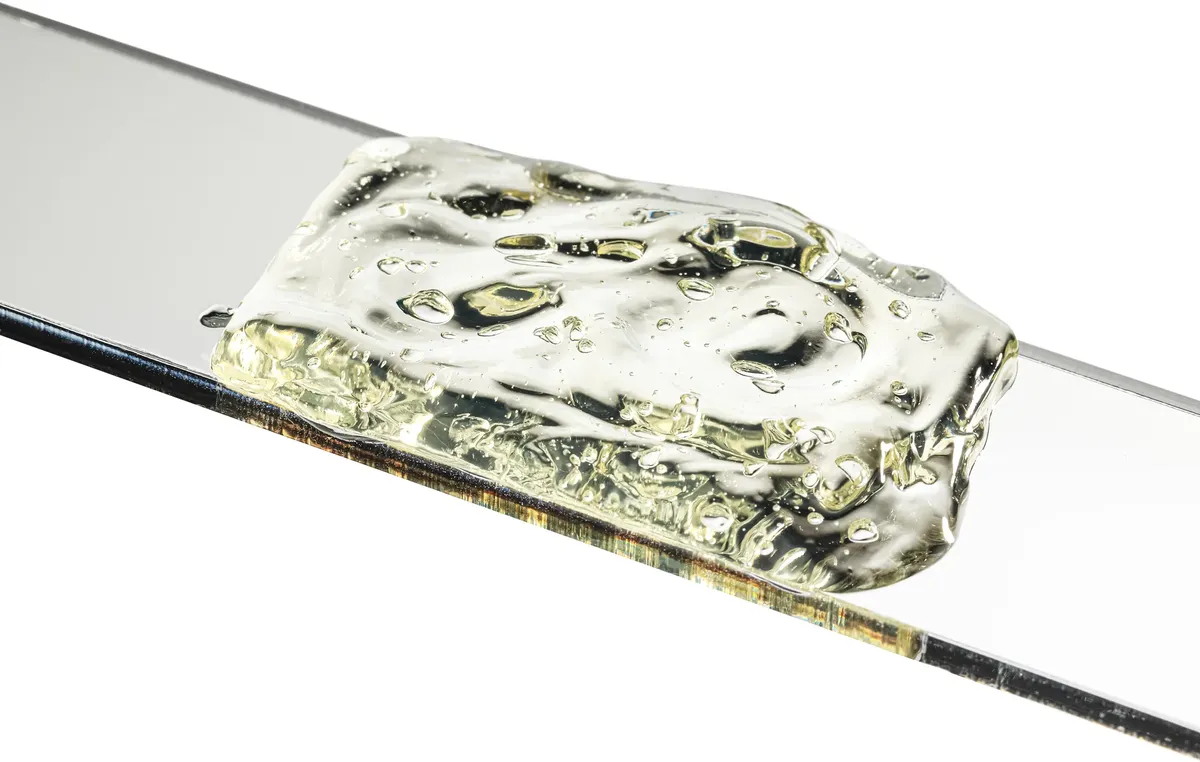
The amino groups can take part in the selected epoxy reaction while the silane end addresses suitable inorganic surfaces. In Epoxy Structural Adhesives and Dissimilar-Material Assembly, select the receiving component around the actual hardener package.
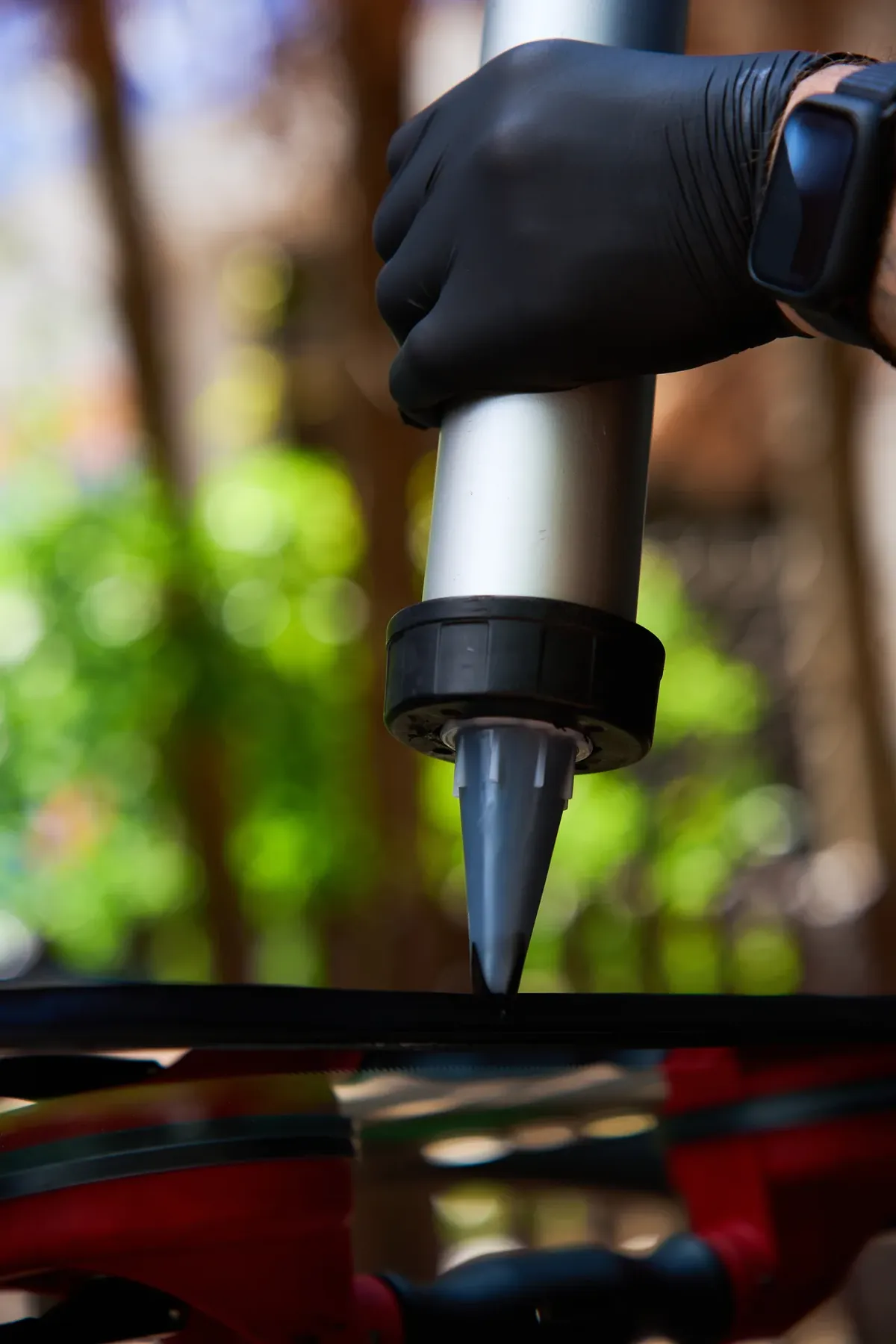
Amine reaction with isocyanate consumes NCO groups and forms urea connections. Polyurethane Industrial Assembly Adhesives offers a formulation context for studying that reactivity and its contribution to the interface.

A separate primer positions the amino silane on a prepared substrate before bonding. In Glass and Ceramic Bonding Primers, deposition, drying and the next adhesive layer form one coordinated process.

Consider the grade for suitable inorganic interfaces in compatible epoxy or phenolic molding formulations. Mineral-Filled Thermoset Molding Compounds involves the filler, organic binder and cure package together.
Use LEGRA 1041-L as an upstream building block in a defined reaction with suitable silanol partners. For Amino-Functional Silicone Synthesis, characterize the resulting polymer before developing a textile auxiliary or another finished formulation from it.
Decide whether the silane will reach the surface through pretreatment, a primer or direct incorporation. Manage methoxy hydrolysis and methanol removal separately from the amino reactions with the binder. Define the actual water balance, mixing order, drying and application window.
Compare fresh and stored formulations for viscosity, working time, cure and conditioned bonding. Primary and secondary amines require their own reaction assessment; total nitrogen or titrated basicity alone does not describe useful epoxy or NCO equivalents. In prepolymer synthesis, track NCO consumption alongside viscosity, molecular distribution and retained hydrolyzable groups. Loss of an NCO signal alone does not establish exclusive terminal attachment or free-monomer concentration.
For silicone synthesis, assess residual methoxy and silanol groups, volatiles and chain distribution. Two methoxy groups do not establish a linear architecture or predict elongation. Include catalyst compatibility in formulation trials, especially when amino-treated materials contact platinum-catalyzed silicones.
These levels are starting points. Determine the optimum level and method in trials under your own production conditions.

LEGRA 1041-L has an aminoethyl segment that introduces a second nitrogen environment. LEGRA 1031-L has one primary amine; both have methyl dimethoxy substitution at silicon.
It is a small-molecule silane ingredient. A finished polymer requires its own synthesis, characterization and formulation development.
It is a controlled-reaction candidate. Multiple amino reaction sites can change chain connection and viscosity, so the intended architecture and endpoint need to be defined.
They describe available hydrolysis sites at silicon. Elongation is a property of the complete cured formulation and depends on its network and other ingredients.

LANDUSIL offers evaluation samples, current TDS and SDS, and material-selection support. Please include: