
Technical Data Sheet
LANDUSIL LEGRA 1071-L
Specification limits, typical properties, guidelines for use, handling, storage and packaging in one document.
FamilyGrades

LEGRA · Amino & Nitrogen-Functional Silanes
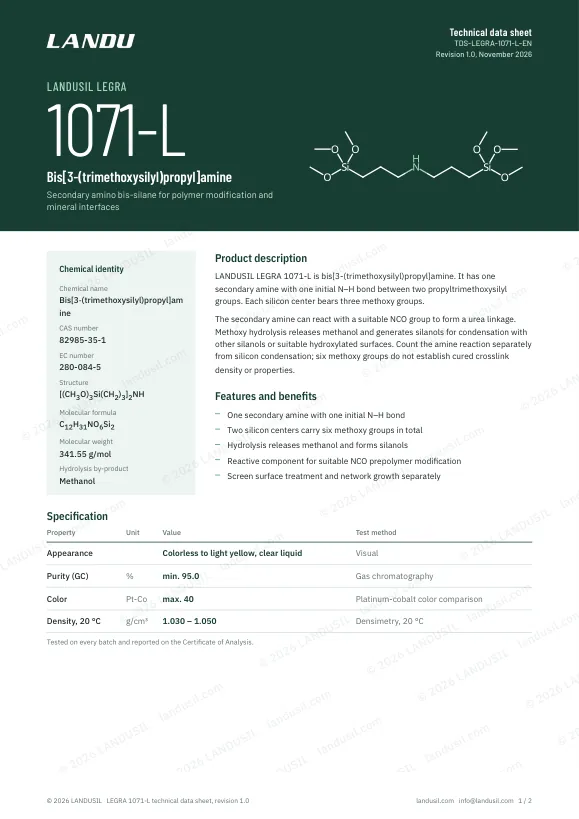
LANDUSIL LEGRA 1071-L is bis(3-trimethoxysilylpropyl)amine (CAS 82985-35-1), a secondary amino silane that brings two silicon ends into a single molecule. It offers a route to reactive polymer modification and suitable inorganic–organic interfaces through one amine and two trimethoxysilylpropyl groups.
The two silicon atoms carry six methoxy groups in total. This gives you a different condensation design from a single-silicon amino silane while retaining one initial N–H reaction site at the secondary amine.

| Item | Information |
|---|---|
| Product | LANDUSIL LEGRA 1071-L |
| Chemical name | Bis[3-(trimethoxysilyl)propyl]amine |
| Alternative name | Bis[3-(trimethoxysilyl)propyl]amine |
| CAS number | 82985-35-1 |
| Molecular formula | C12H31NO6Si2 |
| Molecular weight | 341.55 g/mol |
| Structure | [(CH3O)3Si(CH2)3]2NH |
| EC number | 280-084-5 |
| Hydrolysis by-product | Methanol |
| Product family | Amino & Nitrogen-Functional Silanes |
| Property | Value | Test method |
|---|---|---|
| Appearance | Colorless to light yellow, clear liquid | Visual |
| Purity (GC) | min. 95.0 % | Gas chromatography |
| Color | max. 40 Pt-Co | Platinum-cobalt color comparison |
| Density, 20 °C | 1.030 – 1.050 g/cm³ | Densimetry, 20 °C |
| Property | Typical value |
|---|---|
| Boiling point, 4 mmHg | approx. 152 °C |
| Refractive index, nD20 | approx. 1.432 |
| Dynamic viscosity, 20 °C | approx. 6.5 mPa·s |
| Behavior in water | Hydrolyzes and releases methanol |
| Flash point | >110 °C |
Typical values are provided for reference only and are not to be construed as specifications. Please refer to the current Technical Data Sheet (TDS) and Certificate of Analysis (CoA) for the supplied grade.
Technical Data Sheet
Specification limits, typical properties, guidelines for use, handling, storage and packaging in one document.

Use the secondary amine in a controlled reaction with a suitable NCO-terminated prepolymer. In Silane-Terminated Polymer Synthesis, this is an upstream manufacturing step that introduces two silicon ends per incorporated silane molecule.

The secondary amino group can participate in a selected epoxy formulation. Epoxy Structural Adhesives and Dissimilar-Material Assembly provides the application context for positioning the silane in a defined component or at a separately treated surface.

A formulated primer places hydrolyzable silicon groups and amino functionality near the substrate–adhesive interface. In Glass and Ceramic Bonding Primers, the prepared surface, treatment layer and receiving adhesive need to work together.

Explore controlled deposition on suitable hydroxylated fillers before resin incorporation. For Quartz and Fused Silica Treatment, the two silicon ends are a specific variable in treatment-layer formation and particle interaction.

Consider the silane within a compatible phenolic mineral-fiber binder. Mineral Wool & Glass Wool Insulation involves fiber wetting, binder distribution and the actual curing operation as well as the chemical interface.
Count the amine reaction and silicon condensation separately. In NCO modification, establish measured prepolymer functionality, amine assay, addition order and heat removal before defining the endpoint. One initial secondary-amine reaction brings in a molecule containing two silicon atoms; it does not make the starting material a diamine chain extender.
For surface treatment, control water, concentration and drying to guide deposition. Methoxy hydrolysis releases methanol and forms silanols. Solution growth and particle bridging can develop alongside the intended surface reaction, so compare bath behavior and dispersion at matched filler loading.
Assess residual reactants, viscosity, storage and final moisture cure in polymer trials. Evaluate initial and conditioned adhesion and failure mode in primer trials. Use separate analytical methods for NCO conversion and free diisocyanate concentration. Six methoxy groups describe available chemistry, rather than achieved crosslink density or strength. Establish catalyst compatibility in the complete formulation, including any contact with platinum-catalyzed silicone, and characterize the finished binder before qualifying an end use.
Trial addition levels are starting points. Determine the optimum level and method in trials under your own production conditions.

LEGRA 1071-L contains two silicon atoms and one amino nitrogen. A diamino silane contains two amino nitrogen environments.
There are six in total, with three on each silicon atom. Their hydrolysis releases methanol.
A change introduces a different number of silicon groups per amino reaction. Compare stoichiometry, network development and processing in the actual formulation.
Treatment amount and condensation affect both surface coverage and particle interaction. Evaluate dispersion alongside layer formation and slurry or compound viscosity.

LANDUSIL provides samples, TDS, SDS and technical selection support. Please include: