

Electronics & Electrical
Silicone Ingredients for LED Optics
An LED encapsulant and a molded lens place different demands on filling, cured shape and the light path. Silicone ingredients for LED optics help developers build a transparent material around the device geometry, target optical response and manufacturing window.
LANDUSIL supplies reactive PDMS, Si–H components and vinyl or phenyl silicone resins for optical-material development. LED resin, molded-optics and optical-sensor formulators can compare methyl addition-cure networks with phenyl-containing resin approaches using the actual optical stack.
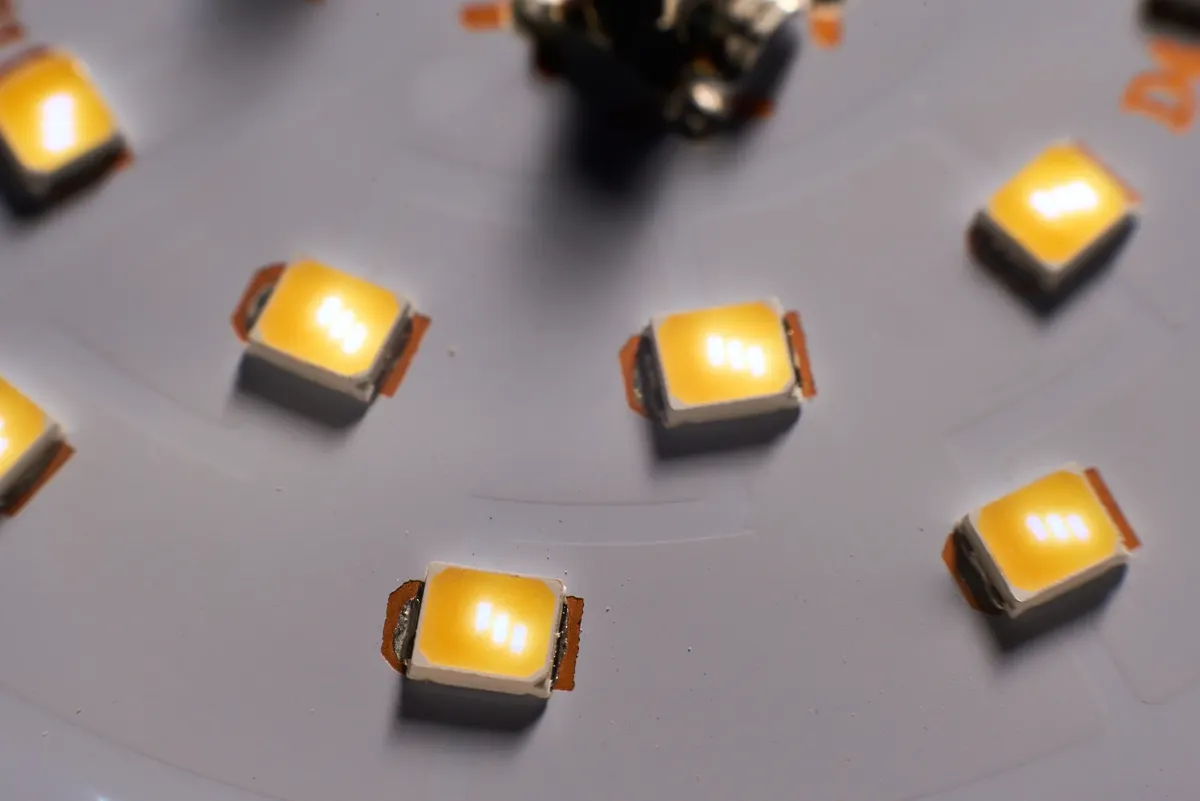
What Silicone Ingredients for LED Optics Do
- Build a reactive network. Vinyl polymer and a matched Si–H component provide the framework for an addition-cure optical elastomer.
- Offer resin design choices. Vinyl resins add a reactive resin phase for adjusting the mechanical and processing balance.
- Offer phenyl resin chemistry. Phenyl resin ingredients support development around a defined index and optical target.
- Support filling and molding. Polymer and resin selection lets you address air removal, cavity filling and molded-part response.
- Connect optical and interface design. Formulation choices can be studied alongside housings, metallization and the transparent layer.
Typical Uses
End use: Clear LED encapsulation
What matters most
Spectral transmission, cure and adhesion in the package
End use: Phosphor-containing encapsulation
What matters most
Dispersion, settling, air entrapment and local optical response
End use: Molded silicone lenses
What matters most
Dimensional fidelity, surface quality and cured mechanics
End use: Transparent sensor encapsulation
What matters most
Layer shape, optical distortion and device response
End use: Index-matching blends
What matters most
Measured index, phase compatibility and retention of mobile material
End use: Light- and heat-exposed protection
What matters most
Color, haze, cracking and interface behavior through conditioning
Recommended LANDUSIL Products
LANDUSIL DUVERA 5020-L supplies a vinyl-terminated PDMS base polymer. The resin grades below address distinct network or phenyl-material studies.
| Product | Chemistry | CAS | Why choose it |
|---|---|---|---|
| DUVERA 5020-L | Vinyl-terminated PDMS | 68083-19-2 | Polymer component for a matched addition-cure formulation |
| DUVERA 4020-L | Methylhydrosiloxane-dimethylsiloxane copolymer | 68037-59-2 | Si–H reaction partner selected by its actual functionality |
| NOVERA 3010-L | Vinyl MQ silicone resin | See SDS | Reactive MQ resin for network and optical-uniformity studies |
| NOVERA 5010-L | Vinyl-functional silicone resin | See SDS | Vinyl resin approach selected by its own structure and carrier |
| NOVERA 2060-L-HP | Phenyl silicone resin | See SDS | Phenyl resin ingredient with grade-specific reactive and impurity requirements |
| NOVERA 2020-L | Phenyl-containing silicone resin | See SDS | Additional phenyl resin approach for a defined optical and cure target |
| LANDUSIL DUVERA 6020-L | Phenyl Trimethicone | 70131-69-0 | Phenyl-containing silicone fluid for evaluating optical and compatibility behavior in phenyl-silicone formulations |
How to Select an Optical Silicone Approach
Methyl addition-cure networks
Match actual vinyl and hydride equivalents across the polymer, Si–H component and reactive resin. Select the catalyst and cure-control package together with the temperature limit of the device. Terminal and pendant reactive sites contribute differently to network structure, molding response and mechanics.
Phenyl-containing materials
Establish the phenyl resin's structure, functional groups and supply form before selecting its reaction partners. Compare methyl and phenyl approaches within the intended optical stack. Index, transmission and cured mechanical response each contribute to the choice.
Resin phase and compatible fluids
NOVERA 3010-L provides a vinyl MQ identity; NOVERA 5010-L provides a vinyl-functional resin with its own architecture. Select each by actual reactive content and compatibility. When studying a nonreactive fluid in a blend, include its retention and effect on phase behavior as part of the design.
Clear and phosphor-containing formulations
Use a clear formulation reference when introducing phosphor. Record its identity, size distribution, loading and mixing history. Examine dispersion and settling through the process while keeping the intended optical path and cured geometry consistent.
Application and Evaluation Guidelines
Measure refractive index with wavelength, temperature and material state recorded. Compare cured samples at representative thickness for transmission, haze and color. Inspect bubbles, particles, phase separation and local thickness changes, then check the molded surface or encapsulated device.
Screen cure against the actual phosphor, housing, metallization and interface treatments. Include residual volatiles and mobile material that could reach neighboring surfaces. HP in a grade code does not establish impurity levels; use the relevant lot documentation and analytical requirements for the process.
Assess water transport and interface behavior in the complete construction. A clear resin result cannot predict every phosphor-filled material. Track the optical layer, housing, leads and interfaces during the relevant moisture exposure.
Use the intended spectrum, intensity, temperature and atmosphere for light and thermal ageing. Compare transmission, haze, yellowing, cracking and device output or sensor function. Optical stability requires formulation-specific evidence, and short exposure or thermal decomposition data cannot supply an operating lifetime.
Frequently Asked Questions
Which ingredients form a methyl addition-cure optical silicone?
A vinyl-functional polysiloxane, a matched Si–H component and catalyst form the starting network. Reactive resins may be included to adjust the mechanical and processing balance.
How should refractive index be compared between formulations?
Use the same wavelength, temperature and material state. Measure the cured optical construction at representative thickness alongside spectral transmission, haze and color.
What should be checked when adding phosphor to silicone?
Check dispersion, settling, trapped air, cure and local optical uniformity. Compare the filled formulation with its clear reference and evaluate the complete LED package.
Which measurements matter for a molded silicone lens?
Inspect dimensions and surface quality, then measure the relevant optical spectrum and mechanical response. Repeat the selected checks after light and thermal exposure suited to the device.

Samples and Technical Support
LANDUSIL offers samples, TDS, SDS and material-selection support. Include:
- Device type, wavelength and light-exposure conditions
- Target index, layer thickness or lens geometry
- Phosphor, housing and other contacting materials
- Mixing, molding, cure and impurity requirements
- Estimated quantity, packaging preference and destination country