
Technical Data Sheet
LANDUSIL LEGRA 3031-L
Specification limits, typical properties, guidelines for use, handling, storage and packaging in one document.
FamilyGrades

LEGRA · Vinyl / Allyl Silanes
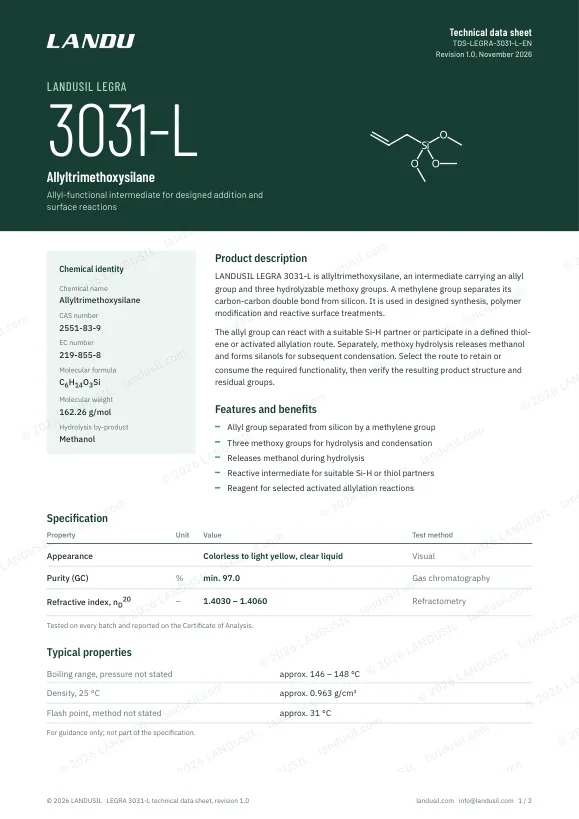
LANDUSIL LEGRA 3031-L is allyltrimethoxysilane (ATMS, CAS 2551-83-9), a reactive intermediate for adding organosilane functionality through a suitable allyl reaction. Its structure, CH2=CH–CH2–Si(OCH3)3, places a methylene spacer between the double bond and silicon.
This gives you a useful building block for reactions with genuine Si–H partners, specified thiol-ene polymers and selected synthetic intermediates. Three methoxy groups remain available for controlled hydrolysis and condensation when the chosen reaction route retains them.

| Item | Information |
|---|---|
| Product | LANDUSIL LEGRA 3031-L |
| Chemical name | Allyltrimethoxysilane |
| CAS number | 2551-83-9 |
| Molecular formula | C6H14O3Si |
| Molecular weight | 162.26 g/mol |
| EC number | 219-855-8 |
| Hydrolysis by-product | Methanol |
| Product family | Vinyl / Allyl Silanes |
| Property | Value | Test method |
|---|---|---|
| Appearance | Colorless to light yellow, clear liquid | Visual |
| Purity (GC) | min. 97.0 % | Gas chromatography |
| Refractive index, nD20 | 1.4030 – 1.4060 | Refractometry |
| Property | Typical value |
|---|---|
| Boiling range, pressure not stated | approx. 146 – 148 °C |
| Density, 25 °C | approx. 0.963 g/cm³ |
| Flash point, method not stated | approx. 31 °C |
Typical values are provided for reference only and are not to be construed as specifications. Please refer to the current Technical Data Sheet (TDS) and Certificate of Analysis (CoA) for the supplied grade.
Technical Data Sheet
Specification limits, typical properties, guidelines for use, handling, storage and packaging in one document.

React the allyl group with a selected Si–H material under an appropriate catalytic route to make a new silane-bearing intermediate. Functional silane and organosilicon intermediate synthesis starts with the target structure, the location of the partner's Si–H groups and the methoxy functionality you want to retain.

LEGRA 3031-L can supply allyl functionality in a specified thiol-ene polymer or another compatible attachment process. For silicone-modified acrylic and vinyl polymers, match the organic reaction to the actual polymer design and preserve the silane groups needed for the later interface step.

Hydrolyzed methoxy groups provide a route to treating suitable glass and hydroxylated mineral surfaces. In glass fiber and FRP construction composites, select a resin and reaction partner that can use the retained allyl group, and develop the treatment alongside the sizing or composite process.
Define the desired product before choosing the reaction. For hydrosilylation, supply Si–H through the actual reaction partner and monitor the resulting structure and allyl conversion. Select catalyst, stoichiometry, moisture control and impurity limits around that partner. For thiol-ene processing, coordinate thiol functionality, initiator and light or thermal activation with the complete polymer recipe.
If the next step uses the trimethoxysilyl group, follow residual methoxy functionality as well as double-bond conversion. During surface treatment, control water and condensation, then assess retained silane after the intended washing or drying process. Measure methanol generation and removal. Three hydrolyzable groups favor branching and network development under suitable conditions; selective linear end-capping requires a specifically designed route.
Evaluate adhesion and cure in your actual substrate–polymer combination, including surface preparation, inhibition, extractables and conditioned bond strength. Allyl and silicon-bound vinyl groups have different reactivity, so qualify any change from a vinyl silane through reaction and process trials. PE pipe and cable grafting need dedicated evidence.
These levels are starting points. Determine the optimum level and method in trials under your own production conditions.

It is a building block for organosilane intermediates and compatible reactive polymers. The allyl group can participate in selected Si–H partner reactions or thiol-ene chemistry, while retained methoxy groups support later hydrolysis and condensation.
Allyltrimethoxysilane has a CH2 spacer between its double bond and silicon. Vinyltrimethoxysilane attaches the vinyl group directly to silicon. This structural difference affects reaction selection and polymer incorporation.
The allyl double bond reacts with Si–H supplied by the chosen partner. LEGRA 3031-L supplies the allyl group and trimethoxysilyl functionality; select a genuine Si–H reagent for the other side of the reaction.

LANDUSIL offers samples, current TDS and SDS, and intermediate-selection support. Please provide: