

LATERA · Titanate Coupling Agents
LANDUSIL LATERA 1010-L Isopropyl Titanium Triisostearate
LANDUSIL LATERA 1010-L is isopropyl titanium triisostearate (TTS, CAS 61417-49-0), a monoalkoxy titanate with isopropoxy and long-chain isostearate ligands. Formulators use this fatty-acid titanate chemistry to develop wetting and compatibility at a mineral or pigment interface with an organic phase.
The practical objective is uniform powder incorporation into the selected resin or elastomer. For filled polymers, concentrates and millbases, you can compare controlled surface pretreatment with a compatible formulation-addition route, using the actual powder and processing conditions.
- CAS number
- 61417-49-0

Product Identity
| Item | Information |
|---|---|
| Product | LANDUSIL LATERA 1010-L |
| Chemical name | Isopropyl Titanium Triisostearate |
| Common abbreviation | TTS |
| CAS number | 61417-49-0 |
| Chemical type | Monoalkoxy fatty-acid titanate |
| Ligand description | Isopropoxy and long-chain isostearate ligands |
| Molecular formula | <span>C57H112O7Ti</span> |
| Molecular weight | 957.36 g/mol |
| Hydrolysis by-product | Isopropanol |
| Product family | Titanate Coupling Agents |
Specifications
| Property | Value | Test method |
|---|---|---|
| Appearance | Yellowish brown to reddish brown liquid | Visual |
| Relative density, 25 °C | 0.920 – 0.960 | Relative density measurement |
Typical Properties
| Property | Typical value |
|---|---|
| Dynamic viscosity, 25 °C | approx. 130 mPa·s |
| Behavior in water | Gradual hydrolysis; direct aqueous use requires qualification |
Typical values are provided for reference only and are not to be construed as specifications. Please refer to the current Technical Data Sheet (TDS) and Certificate of Analysis (CoA) for the supplied grade.
Key Features of Isopropyl Titanium Triisostearate
- Organic-facing ligand structure: long-chain fatty-acid ligands support selection for powder compatibility with an organic receiving phase.
- Mineral treatment route: provides TTS chemistry for controlled treatment of specified carbonate and other mineral surfaces.
- Powder wetting focus: targets the incorporation and distribution of fillers and pigments during mixing or grinding.
- Process choice: allows comparison of powder pretreatment and compatible in-process addition for your equipment and formulation.
- Distinct titanate family: offers a fatty-acid ligand option alongside pyrophosphato and ethylene-chelated titanates.
Applications

Calcium carbonate treatment
For calcium carbonate filler treatment, start with the carbonate type, surface area, moisture and existing coating. A controlled powder-treatment trial connects surface coverage and free residues with later dispersion in the intended polymer.
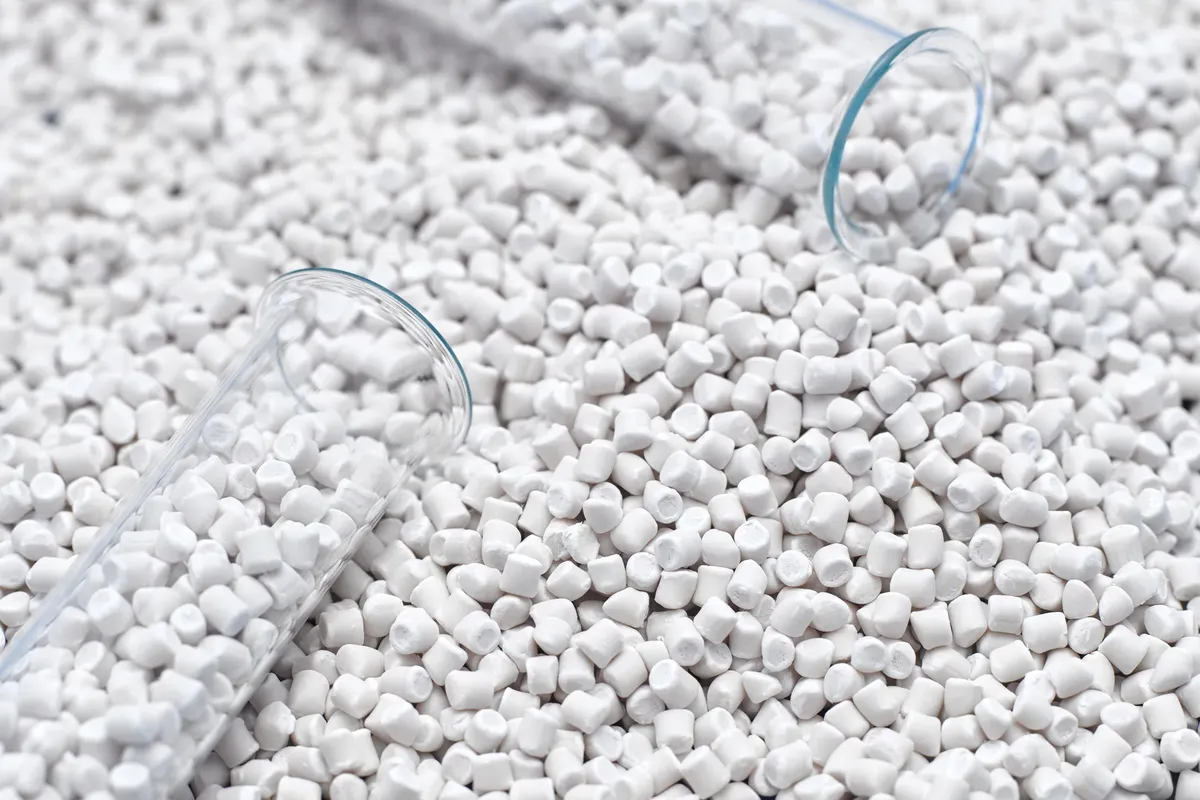
Mineral-filled thermoplastics
In mineral-filled plastics, TTS chemistry can be evaluated for mineral wetting in PP, PE or an identified PVC formulation. Keep the filler loading, stabilizers and lubricants controlled while comparing mixing torque, melt behavior, dispersion and mechanical retention.

High-loading mineral concentrates
For mineral masterbatches, treatment development includes powder feeding, carrier wetting and pellet quality. Follow the concentrate through dilution into the final resin to assess surface quality, deposits and the properties required by the end product.

Pigment concentrates and millbases
In pigment concentrates and high-solids millbases, compare pigment pretreatment with addition during compatible nonaqueous grinding. The relevant controls include pigment surface, grinding resin, dispersant package, fineness, process-shear viscosity and stability after let-down.

Mineral-filled industrial rubber
For mechanical rubber goods, assess the treatment with the specified mineral, elastomer and sulfur-cure package. Mixing dispersion, scorch and cure behavior connect the processing trial to fatigue, abrasion and aging requirements of the part.
How to Use
Identify the powder's existing surface treatment, moisture, particle shape and surface area. Obtain grade information for actual composition, carrier, free acid or alcohol, and usable treatment content. Use those inputs to compare dry-powder pretreatment with a compatible organic-phase addition point.
For pretreatment, distribute the material uniformly through the powder under controlled mixing. For millbase addition, select the receiving resin and medium first and assess interaction with the current dispersants. An aqueous process requires a validated treatment or emulsification route, including water-reaction behavior, drying where applicable and storage stability.
Compare formulations at fixed powder loading before changing the filling level. Measure processing response and final properties together, including migration or plate-out where relevant. Easier flow does not establish stronger reinforcement, resin covalent bonding, flame performance or electrical insulation. TTS has fatty-acid ligands; choose a specifically functional material when your process requires a polymerizable methacrylate group.
Guidelines for use
- Filler-treatment starting range
- Screen 0.2 – 2.0 % by weight of filler. Adjust for powder surface area and existing coatings. Establish free-moisture removal before introducing the liquid and distribute it uniformly in a controlled mixing process.
- Liquid distribution
- Compare metered bulk treatment with a qualified dilution route. Use a dry, compatible diluent only after checking solubility, flash point, ventilation and removal of residual volatile components; mixing temperature requires a process-specific assessment.
- Process verification
- Compare treated and untreated powder at the same filler loading. Establish treatment uniformity, dispersion and storage before evaluating the final compound. Qualify emulsification, residence time and drying separately for any water-based treatment.
These levels are starting points. Where no numerical level is specified, determine the charge or concentration in process trials. Validate the method, product composition and operating conditions for your intended use.
Packaging and Storage
- Packaging: 25 kg plastic drum, 200 kg steel drum, 1,000 kg IBC. Other pack sizes on request.
- Storage: Store indoors, protected from sunlight, in a cool, dry, ventilated place with the original container tightly sealed. Prevent moisture and contamination during withdrawal and close promptly after use. Shelf life is 12 months from manufacture in unopened original packaging under these conditions. Check appearance after storage.
- Handling and safety: Combustible liquid. Keep away from heat and ignition sources and control vapor and mist during transfer and mixing. Use suitable chemical-resistant gloves and eye protection with effective ventilation. Avoid skin contact and inhalation. Moisture can cause hydrolysis and gel formation; alkoxy-group hydrolysis can release isopropanol. Keep transfer equipment dry and control spills. Read the Safety Data Sheet before use.

Frequently Asked Questions
What is isopropyl titanium triisostearate used for?
TTS chemistry is used in powder–organic-phase interface development, including mineral-filled plastics, concentrates, rubber and pigment millbases. The powder and receiving formulation determine the trial route.
Should TTS be added to the powder or the resin?
Compare controlled powder pretreatment with a compatible formulation-addition step. Choose the route using treatment uniformity, moisture control, processing response and final-product tests.
How do I evaluate TTS in a pigment millbase?
Keep pigment and resin conditions fixed. Measure fineness, shear-dependent viscosity, color strength, settling and let-down stability, while checking compatibility with existing dispersants.

Samples, TDS and Technical Support
LANDUSIL supplies samples, TDS, SDS and material-selection support. Please include:
- Powder identity, surface treatment, particle size and moisture
- Receiving resin or elastomer, cure package and proposed addition point
- Mixing or grinding process and target test results
- Estimated quantity, packaging preference and destination country