
Technical Data Sheet
LANDUSIL LEGRA 8030-L
Specification limits, typical properties, guidelines for use, handling, storage and packaging in one document.
FamilyGrades

LEGRA · Mercapto & Sulfur-Containing Silanes
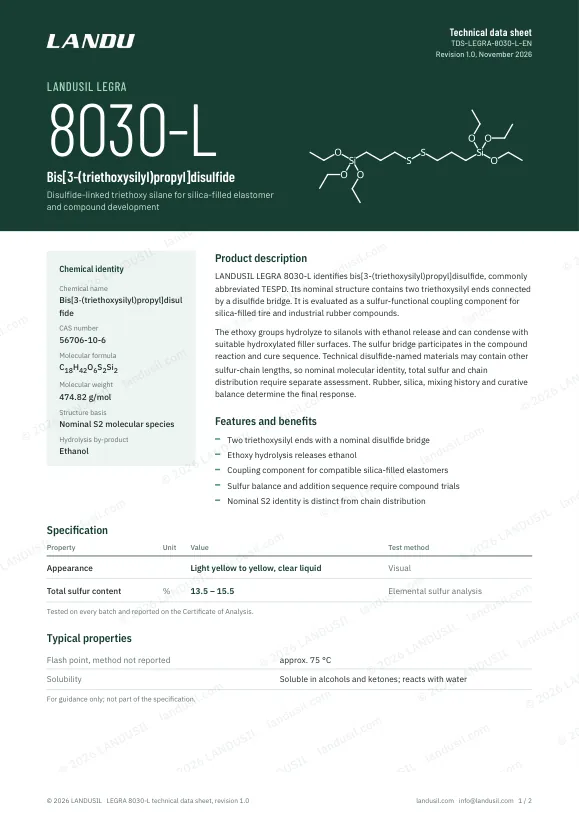
LANDUSIL LEGRA 8030-L is bis[3-(triethoxysilyl)propyl]disulfide, or TESPD, CAS 56706-10-6. Its nominal structure joins two triethoxysilyl ends through a disulfide bridge, combining silica-surface chemistry with a sulfur-containing connection for compatible rubber systems.
For compounders, the main development choices are sulfur balance and addition route. You can investigate coupling during mixing or use silica treated before compounding, then compare processing and cured properties on a defined material and curative basis.

| Item | Information |
|---|---|
| Product | LANDUSIL LEGRA 8030-L |
| Chemical name | Bis[3-(triethoxysilyl)propyl]disulfide |
| Common abbreviation | TESPD |
| CAS number | 56706-10-6 |
| Nominal molecular formula | C18H42O6S2Si2 |
| Nominal molecular weight | 474.82 g/mol |
| Functional structure | Two triethoxysilyl ends connected by a disulfide bridge |
| Molecular formula | C18H42O6S2Si2 |
| Molecular weight | 474.82 g/mol |
| Structure basis | Nominal S2 molecular species |
| Hydrolysis by-product | Ethanol |
| Product family | Mercapto & Sulfur-Containing Silanes |
| Property | Value | Test method |
|---|---|---|
| Appearance | Light yellow to yellow, clear liquid | Visual |
| Total sulfur content | 13.5 – 15.5 % | Elemental sulfur analysis |
| Property | Typical value |
|---|---|
| Flash point, method not reported | approx. 75 °C |
| Solubility | Soluble in alcohols and ketones; reacts with water |
| Density | 1.03 (unit/temp unstated) |
| Refractive index | 1.457 |
Typical values are provided for reference only and are not to be construed as specifications. Please refer to the current Technical Data Sheet (TDS) and Certificate of Analysis (CoA) for the supplied grade.
Technical Data Sheet
Specification limits, typical properties, guidelines for use, handling, storage and packaging in one document.

Use TESPD in silica-reinforced tire-compound development with the chosen rubber blend, filler and complete sulfur package. Define the silanization stage and sulfur-addition sequence so that processing and cure can be compared meaningfully.

The disulfide route also supports mechanical rubber goods containing appropriate silica and cure chemistry. Set the test priorities around the part's fatigue, abrasion, compression, media exposure and ageing requirements.

TESPD can be studied during silica pretreatment for rubber, followed by incorporation of the resulting powder into the target compound. Control the surface reaction, unbound silane, ethanol removal, flow and storage properties of the treated filler.
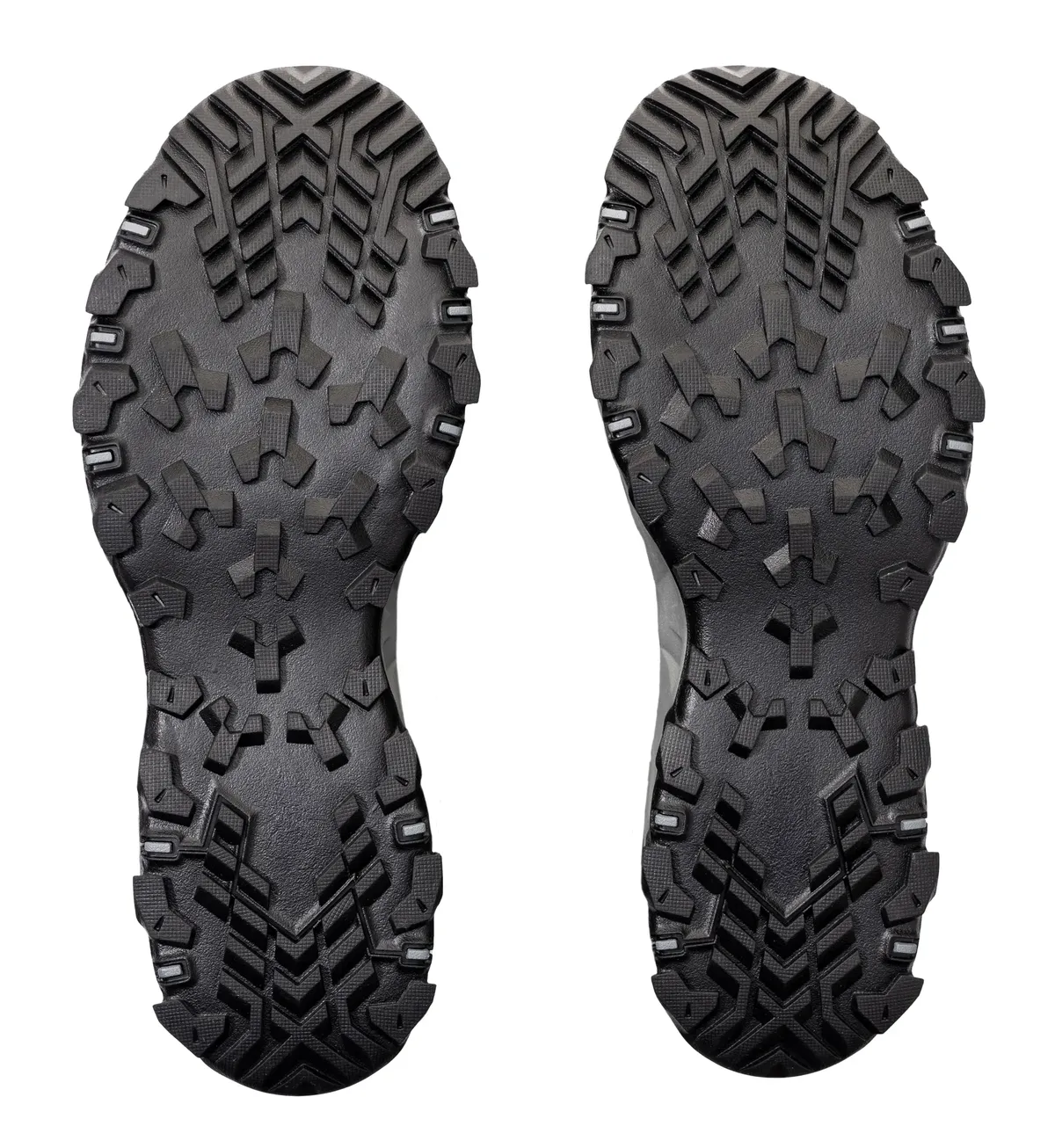
For silica-filled rubber soles and colored compounds, couple silane selection with rubber, pigment and curative choice. Evaluate abrasion, wet grip, flexing and appearance using the intended outsole process and formulation.
Confirm current composition, sulfur content, chain-length distribution and carrier or dilution information before choosing a trial level. The nominal disulfide formula is not a batch assay. Set comparisons on the confirmed material basis and include the complete sulfur and accelerator package.
For direct mixing, record silica moisture, addition order, temperature history, mixing duration, torque and ethanol removal. Follow scorch and cure curves together with dispersion and the final compound's mechanical, dynamic and ageing properties. Include the stage of sulfur addition in your records, because mixing-stage and later mill additions can produce different responses.
For pretreatment, account for silane already attached to the filler when comparing powder masses with a direct-addition formulation. Check residual free material, powder storage and the receiving compound's cure behavior. Carrier concentrates, pretreated silica and liquid feed represent different delivery routes. Compare TESPD with tetrasulfide or free-thiol silanes using formulation-specific sulfur balance and process conditions.
These levels are starting points. Determine the optimum level and method in trials under your own production conditions.

TESPD is used to develop silica coupling in compatible sulfur-cured rubber. It can be studied during mixing or in a filler-pretreatment stage before compounding.
Confirm composition and sulfur contribution, then compare the complete cure packages and mixing sequences. Record scorch, cure, dispersion and the service properties relevant to your compound.
Yes. Sulfur added during internal mixing and sulfur added later on a mill can produce different processing and cured responses. Include addition timing in the trial design.
Check silane attachment, unbound material, volatile residues, powder flow and storage. Then test dispersion, scorch and cure in the intended rubber formulation.

LANDUSIL provides samples, current TDS and SDS, and selection support. Please include: